What "Proprietary Blend" Means: How to Read the Cardioflush Label When Amounts Aren't Disclosed
Quick Answer: What Does Cardioflush's Proprietary Blend Actually Tell You?
It tells you the total weight of six combined herbs, and it tells you their names, their botanical species, the plant part used for each, and — for two of the six — a standardization percentage. It does not tell you how many of the 195 total milligrams belong to any single ingredient. That is what "proprietary blend" means on a U.S. supplement label: a legally permitted format that discloses group weight rather than individual amounts. This article walks through exactly what is and isn't disclosed, looks at motherwort specifically (the one blend ingredient our other two articles don't cover), and lays out who should check with a doctor before taking this or any similar product.
- Disclosed: all six ingredient names, species, plant parts, and the 195mg blend total.
- Not disclosed: the milligram amount of any single one of the six ingredients.
- Standardized: only 2 of 6 (grape seed, horse chestnut) carry a printed potency percentage.
What's printed on Cardioflush's Supplement Facts panel
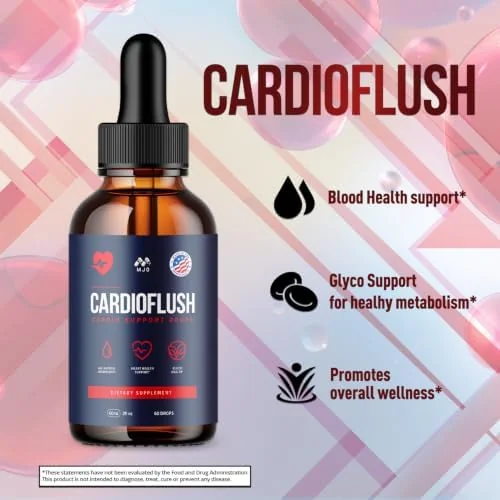
Cardioflush ("CARDIOFLUSH — CARDIO SUPPORT DROPS") is a liquid dietary supplement, distributed by MJO of Sheridan, Wyoming, sold in an amber glass dropper bottle. The label's serving size is 2ml (two droppers), with 30 servings per 60mL (2 fl oz) bottle. The entire ingredient disclosure for the active portion of the formula is a single line: "Proprietary Blend — 195mg," with "**" next to it, meaning "Daily Value not established." Underneath that line, the label names six botanicals in this printed order:
- Grape Seed (Vitis vinifera) Extract — standardized to >95% Proanthocyanidins
- Horse Chestnut (Aesculus hippocastanum) Extract — standardized to >20% Aescin
- Motherwort (Leonurus japonicus whole herb) Extract — no standardization printed
- Hawthorn Berry (Crataegus asiatica aerial) Extract — no standardization printed
- Gotu Kola (Centella asiatica aerial) Extract — no standardization printed
- Butcher's Broom (Ruscus aculeatus leaf/stem) Extract — no standardization printed
Below the botanicals, the "Other Ingredients" line reads: "RO water, Glycerin, Citric acid, Potassium Sorbate and Sodium Benzoate (natural preservatives) stevia leaf extract," — the line ends on a trailing comma on the label image we reviewed, so it is possible additional text is cut off and not visible in the source photograph. Directions read: "Shake bottle well. Take 2ml orally once daily or as directed by your healthcare provider," with a caution to "check with your doctor before using this product if you are using medication or have any medical conditions." We also noticed a separate front-panel graphic on the bottle that says "Take 2 Drops daily," which conflicts with the printed Supplement Facts serving size of 2ml (two droppers). The two are not the same measurement, and the listing does not explain the discrepancy anywhere we could find; the printed Supplement Facts panel is the standardized, legally governed disclosure, so we treat it as the authoritative figure over a front-panel graphic.
What "proprietary blend" means, in plain terms
Under U.S. dietary supplement labeling regulations, a manufacturer is allowed to group several ingredients under one heading — commonly called a "proprietary blend," "formula blend" or similar — and disclose only the combined weight of that group, rather than breaking out each ingredient's individual amount. The one rule that still applies: the ingredients inside the blend must be listed in descending order by weight, heaviest first. That is why Cardioflush's label, and thousands of other supplement labels, can legally print "195mg" next to six botanical names without saying how those 195 milligrams are divided among them.
This format exists for legitimate business reasons — primarily to make it harder for a competitor to reverse-engineer a formula — and it is extremely common across the supplement industry, not unique to Cardioflush. But it has a real cost for the buyer: without individual amounts, there is no way to check any single ingredient's disclosed dose against the doses used in that ingredient's own clinical research. Our companion articles on horse chestnut's trial dose vs. Cardioflush's label and on gotu kola and butcher's broom's research walk through exactly this problem for four of the six ingredients here. The two ingredients that carry a standardization percentage — grape seed at >95% proanthocyanidins and horse chestnut at >20% aescin — are a partial exception: a standardization tells you the concentration of active compound within the extract itself, which is useful information, but it still is not the same as knowing how many milligrams of that extract are in the bottle. Concentration and quantity are two different numbers, and only the first is available for those two ingredients; neither is available for the other four.
Motherwort: the one ingredient our other articles don't cover
Motherwort is third in Cardioflush's printed ingredient order, described as "Motherwort (Leonurus japonicus whole herb) Extract." Motherwort is a flowering herb in the mint family with a long traditional-medicine history: in European herbalism (associated with the related species Leonurus cardiaca) it was historically used for heart palpitations, anxiety-related heart symptoms, and as a calming nervine; in Chinese medicine, Leonurus japonicus specifically (the species named on this label, sometimes called Chinese motherwort or "yi mu cao") has a separate traditional history, more centered on women's health and circulation. A detailed 2013 phytochemistry and pharmacology review covering Leonurus cardiaca summarizes laboratory and animal research on the plant's alkaloids (including stachydrine and leonurine) and diterpenoids, which have shown cardiotonic, mild sedative and uterine-stimulant activity in preclinical models.[1] A separate, more targeted review specifically of Leonurus japonicus — the exact species printed on the Cardioflush label — covers its ethnopharmacology and documents similar pharmacological findings in laboratory and animal studies, including cardiovascular and antioxidant effects attributed to its alkaloid and flavonoid content.[2]
What neither review reports is a well-powered, modern human randomized controlled trial testing motherwort, alone, for a cardiovascular outcome in people. The pharmacological picture is built substantially from laboratory (in vitro) and animal research, plus centuries of traditional use, rather than the kind of placebo-controlled human trial evidence available for horse chestnut, gotu kola or butcher's broom, discussed in our other two articles. That is a meaningfully different evidence category, and it's worth being direct about it: motherwort's traditional reputation for calming heart palpitations is old and widespread, but the modern human clinical trial record specific to cardiovascular outcomes is thin. As with every ingredient on this label, Cardioflush's printed amount for motherwort is not disclosed — it is somewhere inside the 195mg blend total, in third position by weight, with no percentage or milligram figure given.
All six blend ingredients, side by side
| # | Ingredient (as printed) | Plant part | Standardization printed? | Amount printed? |
|---|---|---|---|---|
| 1 | Grape Seed (Vitis vinifera) Extract | Not stated | Yes — >95% Proanthocyanidins | No |
| 2 | Horse Chestnut (Aesculus hippocastanum) Extract | Not stated | Yes — >20% Aescin | No |
| 3 | Motherwort (Leonurus japonicus) Extract | Whole herb | No | No |
| 4 | Hawthorn Berry (Crataegus asiatica) Extract | Aerial | No | No |
| 5 | Gotu Kola (Centella asiatica) Extract | Aerial | No | No |
| 6 | Butcher's Broom (Ruscus aculeatus) Extract | Leaf/stem | No | No |
Reading this table left to right is, in effect, the whole exercise of label literacy for a proprietary blend: you can verify identity (which species), you can sometimes verify concentration (a standardization percentage, when printed), but you cannot verify quantity unless the manufacturer chooses to disclose it. For Cardioflush, quantity is not disclosed for any of the six ingredients.
A note on where this label comes from
It's worth being precise about sourcing here too. The facts in this article come from the printed Supplement Facts panel on the Cardioflush bottle sold via Amazon under seller/brand "MJO" (ASIN B0H7691R6C). We are not aware of any separate manufacturer website carrying the same label, and no certificate of analysis, third-party lab report, or clinical trial of the finished formula was located. Readers should also know that "Cardioflush" as a product name has separately been used in an unrelated direct-to-consumer marketing campaign with a different, unverified ingredient list circulating online; that other campaign is not the product this label describes, and we have not been able to confirm any relationship between the two. Our information here reflects only the printed Amazon/MJO label — the one real Supplement Facts panel we were able to locate and verify.
Who should not take Cardioflush without talking to a doctor first
Cardioflush's own label carries one general caution: "Check with your doctor before using this product if you are using medication or have any medical conditions." Given what is (and isn't) known about this blend, a few groups deserve that caution more specifically than others:
- Anyone on blood thinners or antiplatelet medication. Horse chestnut and butcher's broom both act on veins and circulation through mechanisms that overlap, at least theoretically, with anticoagulant drug effects.
- Anyone on blood-pressure medication. Several of the six botanicals (hawthorn in particular, and to a lesser extent motherwort and butcher's broom) have documented or theoretical cardiovascular activity that could interact with prescribed blood-pressure or heart-rhythm drugs.
- Anyone pregnant or nursing. Motherwort in particular has a traditional association with uterine activity in some preclinical research; none of these six botanicals, alone or combined, have safety data in pregnancy, and the label does not address pregnancy or nursing at all.
- Anyone with liver or kidney disease. Concentrated botanical extracts are processed through the liver and kidneys, and this blend has not been safety-tested as a finished product in people with organ impairment.
None of this means the product is unsafe for a healthy adult taking it as directed — the label's own caution is a standard, reasonable one for a botanical supplement. It does mean the caution is worth actually following, especially given how much about this specific blend (individual amounts, drug-interaction data, a finished-product trial) remains unverified.
Medical note: this article is general information, not medical advice. It is not a substitute for reading the physical product label yourself or for a conversation with a pharmacist or physician. If you are pregnant, nursing, taking any prescription medication (especially blood thinners, blood-pressure medication or heart medication), or managing a chronic health condition, speak to a healthcare professional before starting Cardioflush or any similar proprietary-blend supplement.
Scientific references
- Wojtyniak K, Szymański M, Matławska I — Leonurus cardiaca L. (motherwort): a review of its phytochemistry and pharmacology, Phytotherapy Research, 2013 Aug;27(8):1115-20
- Shang X, Pan H, Wang X, He H, Li M — Leonurus japonicus Houtt.: ethnopharmacology, phytochemistry and pharmacology of an important traditional Chinese medicine, Journal of Ethnopharmacology, 2014 Feb 27;152(1):14-32
- U.S. FDA — Questions and Answers on Dietary Supplements (proprietary blend labeling)
- Cardioflush Supplement Facts panel, as printed on the product label sold via Amazon (ASIN B0H7691R6C), read 26 September 2026.
Related reading
- Horse chestnut (aescin) in Cardioflush: dose vs. trial evidence
- Gotu kola and butcher's broom for venous circulation: what the research shows
- Heart supplement and drug interactions: a safety guide
- Hawthorn, hibiscus and beetroot for heart health
Frequently asked questions
What does "proprietary blend" mean on a supplement label?
It means the manufacturer discloses the combined weight of a group of ingredients but not the individual amount of each one inside that group. U.S. labeling rules allow this as long as the ingredients are listed in descending order by weight. Cardioflush's label uses this format: a single 195mg "Proprietary Blend" total covering six named botanicals, with no per-ingredient milligram figure.
Why doesn't Cardioflush list how much of each ingredient is in the blend?
Because it uses the proprietary blend format, which is legal under U.S. supplement labeling rules and common across the industry, often to protect a formula from being copied by competitors. The tradeoff is that a buyer cannot see the individual amounts and cannot compare them to published research doses for any single ingredient.
What is motherwort and why is it in Cardioflush?
Motherwort (Leonurus japonicus, listed on the label as the whole herb) is a traditional herb used historically in European and Chinese medicine for heart palpitations and nervous-system-related cardiac complaints. Laboratory and animal research has examined its alkaloid and diterpenoid compounds for cardiovascular and calming effects, but large human clinical trials are limited, and no amount is disclosed on this label.
Who should not take Cardioflush?
Cardioflush's own label says to check with a doctor before use if you are taking medication or have any medical condition. Because the blend includes several botanicals that can affect blood pressure, clotting or heart rhythm, this caution is particularly relevant for anyone on blood thinners, blood-pressure medication or heart medication, anyone pregnant or nursing, and anyone with liver or kidney disease. This is general information, not medical advice.
See the full Cardioflush label
Read every printed ingredient, serving size and caution before you decide.
Order Cardioflush